 “Life’s barely long enough to get good at one thing. Be careful what you get good at.”
 Monday, March 03, 2014
Random Thought of the Day: The Wisdom of Rust Cohle
“Life’s barely long enough to get good at one thing. Be careful what you get good at.” 


Book Review: The Wide, Carnivorous Sky and Other Monstrous Geographies, by John Langan
 5/5
5/5
This book opens with one of the coolest stories I've read in
awhile: the short, brutal, and, honestly, kind of hilarious "Kids." Within just a
few paragraphs, Langan had me both howling with queasy laughter and
wondering if he was plundering my mind for its deepest fears, and that's
very much the way to my heart. (Other than through my chest, natch.)
The Wide, Carnivorous Sky and Other Monstrous Geographies has been on my TBR list ever since it came out last spring. I can only say I wish I'd gotten to it sooner, because this collection is as close to perfect as it gets. There are no bad stories here, not even any "meh" ones. Just a series of really inventive tales, well told.
Of course I had favorites. But I had several. Besides "Kids," which I won't spoil by even hinting at its contents, there was also "Technicolor," a wild (and darkly genius) take on "The Masque of the Red Death," which may have inspired me to re-evaluate Poe. (I secretly find him awfully florid.) There are two new-Lovecraftian tales: "The Shallows," a slice-of-life story about a man and his mutant crab, going about their business in a world where the Old Ones now control reality; and the truly disturbing "City of the Dog," which takes as its inspiration H.P. Lovecraft's underused ghouls (think "Pickman's Model"), and turns Albany into a carnivorously haunted blot on the landscape. Finally, the closing, and longest, tale in the collection is "Mother of Stone," in which a bloody pre-historic rite is accidentally resurrected when a strange statue is unearthed at an otherwise homey Hudson Valley inn. Also, do not miss Langan's end notes (which illuminate several of the stories in unexpected ways), and Laird Barron's hilarious afterword. Final rave goes to Santiago Caruso for the gorgeous cover art. Let's look at it again:

Bottom line: The Wide, Carnivorous Sky and Other Monstrous Geographies is an excellent collection, and is so very going on my best-of-2013 list . . . just a little late. If you like weird fiction with just a twist of dark humor, do not miss it.
The Wide, Carnivorous Sky and Other Monstrous Geographies has been on my TBR list ever since it came out last spring. I can only say I wish I'd gotten to it sooner, because this collection is as close to perfect as it gets. There are no bad stories here, not even any "meh" ones. Just a series of really inventive tales, well told.
Of course I had favorites. But I had several. Besides "Kids," which I won't spoil by even hinting at its contents, there was also "Technicolor," a wild (and darkly genius) take on "The Masque of the Red Death," which may have inspired me to re-evaluate Poe. (I secretly find him awfully florid.) There are two new-Lovecraftian tales: "The Shallows," a slice-of-life story about a man and his mutant crab, going about their business in a world where the Old Ones now control reality; and the truly disturbing "City of the Dog," which takes as its inspiration H.P. Lovecraft's underused ghouls (think "Pickman's Model"), and turns Albany into a carnivorously haunted blot on the landscape. Finally, the closing, and longest, tale in the collection is "Mother of Stone," in which a bloody pre-historic rite is accidentally resurrected when a strange statue is unearthed at an otherwise homey Hudson Valley inn. Also, do not miss Langan's end notes (which illuminate several of the stories in unexpected ways), and Laird Barron's hilarious afterword. Final rave goes to Santiago Caruso for the gorgeous cover art. Let's look at it again:
Bottom line: The Wide, Carnivorous Sky and Other Monstrous Geographies is an excellent collection, and is so very going on my best-of-2013 list . . . just a little late. If you like weird fiction with just a twist of dark humor, do not miss it.
Book Review: A Season in Carcosa, Joseph S. Pulver, Jr., ed.
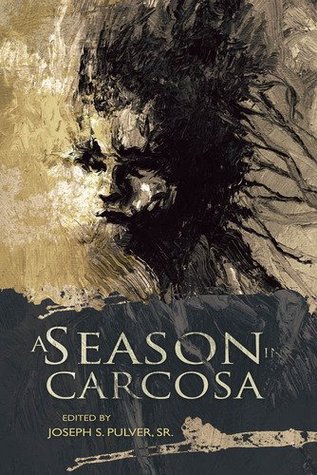 4.5/5 4.5/5
A Season in Carcosa is an exceptionally well-edited tribute anthology in honor of Robert W. Chambers' The King in Yellow and Other Horror Stories,
a story cycle about an accursed play, set in "dim Carcosa," which, when
merely read (never staged!), leaves madness and chaos in its wake.
Chambers' "KiY" stories, though there are only four, left a small but
persistent imprint on the weird, influencing Lovecraft, to start with,
whose Necronomicon owes not a little to that "cursed book"-within-a-book trope.
But on to Pulver's collection: a couple of the tales are a bit mannered for me; for example "The Theater and its Double" by Edward Morris, which marries Artaud's surrealism and "Theater of Cruelty" with the infamous play. I've never much liked the Surrealists, and, though Morris does slip in some beautiful language, that particular story felt bloated and self-indulgent, containing as it does both an imagined version of the play, and "Artaud's" musings on art, politics, morphine, dreams, and the terrors of the Yellow King. Also, Gary McMahon's "it sees me when I'm not looking," which tells a fine tale, but does so with purposefully mangled punctuation and random capitalization, an artistic decision which only made me want to copy-edit it. However, the bulk of the stories evoke the drear decadence of "dead Carcosa" with its pallid masks and its tattered King to uneasy perfection. R.W. Chambers' vision of cosmic horror, though Victorian in its origins, holds up well to contemporary scenarios; issues of mental health and the media's omnipotent hold on our minds underpin many of the stories in the collection. Highlights include "Slick Black Bones and Soft Black Stars," by Gemma Files, in which a Physicians for Human Rights forensic anthropologist investigating a massacre pit unwittingly unearths something still more dreadful; and (the late) Joel Lane's "My Voice is Dead," whose narrator, a devout Catholic losing his religion and dying of cancer, finds faith in Carcosa on the internet. And addressing media manipulation of our collective sanity, we have a fantastic trifecta: John Langan's "Sweetums," in which a struggling actress gets more than she bargained for when hired for an experimental film; in Don Webb's dark and hilarious "Movie Night at Phil's," the wrong videotape puts a gruesome end to a family tradition; and my favorite in the book, Cody Goodfellow's "Wishing Well," in which a mentally unstable former child actor traces his problems back to his role in "Golden Class," a cult children's show something like "Romper Room," only with a lot more creepy masks, ritualistic games, and marionette "visitors" from the "Golden City of Carcosa." I only stumbled over the cult of the King in Yellow by way of its interbreeding with the Lovecraft mythos, and initially I was surprised so many gifted artists are still influenced by Chambers' little-known mythical play-within-a-play. But it certainly spawned one disturbing and compelling collection. It seems as though Chambers' tales may be having a cultural moment -- HBO's slow-burn creepshow "True Detective" referenced Carcosa and the King in Yellow several times in just the first few episodes. Not sure where they are going with it, but I'm hooked. Maybe the time is right for the return of the King? |
Book Review: Let the Old Dreams Die, by John Ajvide Lindqvist
 4/5
4/5Wow, this book took me a long time to read. Not in a bad way; it's just that Lindqvist's first collection of short stores, while beautifully written (and beautifully translated by Ebba Segerberg), is dense, with the majority of the dozen stories on the long side, some to good and others to not-so-great effect.
Fortunately, there were only two stories I simply didn't care for in Let the Old Dreams Die. One, "To Put My Arms Around You, to Music," Linqvist admits in his amusing afterword, nobody but the author himself likes. (So it's okay that my notes on this story consisted of "I don't get it.") The other, "Itsy-Bitsy," is short and sharp modern morality tale about a scheming paparazzo, but its moral is kind of ham-handed, and it's just not of the emotional complexity I've come to expect from Linqvist and his characters. (Ironically, considering what I just said about long stories, I think those two are the shortest in the book.)
Overall, though, the collection is top-notch, with stories dark, surreal and moving all at once. Favorites include: "The Border," in which a middle-aged woman slowly realizes she's something other than she'd always believed (avoiding spoilers here); "Eternal/Love," about a couple who discover how to manipulate Death; "A Village in the Sky," a new-Lovecraftian-tinged tale about an apartment building gone subtly wrong and getting wronger fast; and "Tindalos," a tour-de-force portrait of one woman's anxiety which somehow morphs into a giant monster movie. These last three especially have a cosmic horror vibe that I really loved.
Finally, I'm sure people are wondering about the advertised "sequel" stories to Handling the Undead -- "Final Processing" -- and Let the Right One In -- "Let the Old Dreams Die." So how are they? Harrowing and beautiful, in that order. "Final Processing" brings us up to date on the un-pretty status of the "re-living," and is a pretty grueling read. It's also bordering on novella-length, losing some of its punch along the way. But "Let the Old Dreams Die," which closes the book, is a beautiful love story about a couple who met while working on Oskar's "kidnapping." (She was a cop; he was the station worker who punched Oskar's train ticket the last time he was seen alive. They clicked in the interview room.) The case continues to be an ongoing hobby for the pair, though the trail has long ago gone cold. I won't say any more, but the final page of this story is a little miracle, and a perfect note on which to end. (Except you should also read Lindqvist's afterword, which is funny and self effacing, as well as lending some insight to his madness.)
Book Review: Harrowgate, by Kate Maruyama

5/5
Kate Maruyama's Harrowgate came out of left field late in the year to rock my top ten of 2013. Harrowing (pun intended) yet can't-put-it-down compelling, Maruyama's debut defies genre: a unique family romance that both spooked me and pulled at my heartstrings, romantic and repellent at the same time. I'd love to say more, but you'll be glad I didn't.Harrowgate winks at some familiar tropes -- happy couple in spooky New York apartment? Check. Meddling older woman with special teas? Check. However, it unfolds in a truly unique fashion. An excellent and memorable debut novel. I look forward to much more from Maruyama!
Subscribe to:
Posts (Atom)