Showing posts with label death. Show all posts

Tuesday, November 13, 2012

Book Review: The Fifty Year Sword, by Mark Z. Danielewski

3.5/5
Prefatory note: I take a perverse pleasure in banging my head up against experimental narratives, have ever since grad school. I nearly wrote my thesis on Ulysses; adore Rushdie; will continue to mourn David Foster Wallace. China Mieville is my literary pinup. It's like . . . well, there's this old joke: Twin boys, one a pessimist and one an optimist, are sent to a psychiatrist because their parents are concerned about their personality extremes. By way of testing, the pessimist is shown a room filled with toys, but, afraid he would break them, immediately burst into tears. The junior optimist, however, was brought to a room filled to the ceiling with stinky, sticky manure. He climbed to the top of the pile and started digging gleefully. When asked why he was so pleased by such an awful task, he shrugged and smiled:“With all this shit, there has to be a pony in there somewhere.” I'm the sucker that can't stop believing in poop-covered ponies. Also the person who feels the sting of defeat if I just give up on difficult books. All of which has almost no bearing on The Fifty Year Sword, except by way of explaining how I got involved with reading Mark Z. Danielewski in the first place.
*******
In The Fifty Year Sword, more objet d'art than book-for-reading, Danielewski once again plays with type and page layout and color, and even texture via pinprick holes in the dust cover. (Are there 50 of them? Maybe 100, as if run all the way through? Perhaps; I didn't count.) I know this edition has been breathlessly awaited by those who couldn't get their hands on TFYS before, it having previously been released only in the Netherlands in 2005 and in a limited run of 2,000 copies in English in 2006. It's also been performed in 2010 and 2011 as a staged Halloween reading with shadow theater, which I imagine is a very cool show.

Danielewski's newest experiment-in-print asks nowhere near the commitment that House of Leaves doesnor is it ultimately as satisfying. (HoL has a pony, but the pile is pretty big. Not to say I didn't appreciate the exercise.) On the other hand, The Fifty Year Sword is far less overwrought: ephemeral like a children's tale (though not a tale for children), structured in a simple yet resonant poetic language. It's also quite slight; though the book-object itself logs in at 284 pages, at least half are loosely related artwork. (The art is all tactile, textural stuff, stitches and rips and cut and wrinkled paper. I'm sure it's really interesting in the original, but photos of these things are not.) This being an MZD work, some pages have only a lone word. Or none. They're calling it a novella, but I read it in one long, fascinated hour.

Ready-made to be told around the fire on Halloween (in an echo of the book itself), TFYS is the story of a story told by an uncanny stranger at an annual small-town Halloween party. Hosted by an ancient local eccentric, with both children and adults in attendance, the soiree this year doubles as the 50th birthday party of the local jezebel, Belinda Kite. Seamstress Chintana (the closest to a protagonist the book has) is in reluctant attendance, since her recent, unhappy divorce was a direct result of Ms. Kite's un(whole)some relationship with her husband. Chintana decides instead to spend the evening hidden away with the kids, for whom a storyteller has been arranged. (Does it matter the children are five orphans? Maybe.) And, after extinguishing the porch lights with his arrival, a "shadow cast by nothing," such a tale he has to tell.

Chintana's thumb begins to prickle ominously as she and the children listen wide-eyed to the mysterious Story Teller's tale of his protracted quest to find a magical weapon-smith, and his eventual acquisition of the Fifty Year Sword -- so named because its violence, no matter when dealt, does not reveal itself until the victim's 50th birthday. (The scene in the sword-maker's shop is particularly deft, both charming and subversive, with some of the most resonant bits of language in the book.)

And, perhaps even more interesting than his words, the Story Teller has something with him: a long, thin black box at his feet . . .  a box with five locks, just waiting to be opened.

Typographic visual games are only lightly applied in TFYS, which complements the style of the story. The important exception is MZD's  use of multi-colored quotation marks, each color indicating a different (but ultimately unknown and unknowable) speaker. This tactic renders dialogue into snippets of language, broken and overlapping, as each "speaker" chimes in. Like a palimpsest, under the postmodern antics there's the suggestion of a Greek chorus, breathlessly narrating events as they unfold beneath our impotent gaze. (Here there are only five in the chorus, one-tenth of the originally designated fifty. Yes, fifty.). This technique creates a mytho-poetic resonance that suits TFYS, at its heart a timelessly creepy little tale of hubris, vengeance, and the ofttimes queasy reality of getting a thing you have secretly wanted.

So here I am again, trying to review something that's as much an art project/performance piece as a book, and I come back to a similar problem I had with  House of Leaves. Sometimes the packaging gets in the way of a good story. Make no mistake, the story(ies) that comprise TFYS are compelling: eerie, sinister and viscerally satisfying in exactly the way fairy tales are. But in this case I feel slightly hoodwinked for paying hardback novel price and getting (at best) a slim novella. I know MDZ fanatics needed this edition on their shelves, but I would have been perfectly satisfied with a slim paperback (although that assumes there will be one). I'd recommend checking it out of the library (hell, you could read it without leaving the library!) and saving the cash for a ticket the (theoretical) next time The Fifty Year Sword is performed. Because that would make for a good Halloween.

Thursday, November 01, 2012

Book Review: The Diviners, by Libba Bray

4.75/5
(Mild spoilers ahead)

Libba Bray's The Diviners, yet another YA novel with a seriously dark streak, is set in the glittering Manhattan of the 1920s -- where jazz clubs are hopping, stars are being made, illegal hooch is flowing, and just about anything can happen.

Including the apocalypse.

A small-town girl from Ohio who commits a tipsy and socially ruinous party-foul, seventeen-year-old firecracker Evie O'Neill has been packed off to stay with her bachelor uncle Will in Manhattan (some punishment, right?). Despite the fact that she's stuck with a stuffy academic who runs a creepy museum (formally known as "The Museum of American Folklore, Superstition and the Occult," but mostly referred to as "The Museum of the Creepy Crawlies"), Evie is thrilled at the chance to taste big-city life for herself, and proceeds to duck Will and drag her quiet friend Mabel into fabulously-attired trouble at every opportunity.

But then Will is called to consult on a brutal murder with ritualistic occult overtones, and Evie brashly invites herself along to the crime scene. Here, her "party trick" again rears its ugly head: Evie has the ability to see a person's history just by touching their belongings. And, when she unthinkingly straightens the buckle on the dead girl's shoe, Evie has a vision like never before: she sees the killer, and he's not like you or me. In fact, it's the infamous occultist John Hobbes (also known as Naughty John) . . . and he's been dead for 50 years. Impossible as it may seem, he's back, and he's got a plan to bring on the end times -- one that's going to take several more bloody rituals.
 
Though it takes Evie, Will, and a host of friends (among them Will's taciturn assistant Jericho, shy Mabel, and street-smart scoundrel Sam Lloyd) almost 600 pages to unravel the supernatural killer's complex and gruesome intentions, The Diviners has never dull moment. Manhattan in 1926 is a huge canvas, and Bray brings it to life with flair -- the catchy slang, the clothes, the music, the promise in the air -- so "everything's jake," as Evie might say. The cast is also quite large, and full of vivid characters like iconoclastic Ziegfeld girl Theta; her charming "brother" Henry (read: gay bestie); Memphis, a poet who longs to be part of the Harlem Renaissance but runs numbers in the meantime; and Memphis's little brother Isaiah, who is having apocalyptic visions of his own. Each provides additional interest and intrigue, since they all have unique secrets and nightmares to conceal.
And, as the plot thickens and the killer counts down to a rare comet's appearance in the sky, they all, knowingly or not, play a part in the action.

I'll freely admit I thoroughly enjoyed every page of The Diviners, but do have one or two slight reservations, the foremost being that at times this book is extremely frightening and/or bloody, and it also includes scenes of sexual violence. While I found the book (appealingly) disturbing as a horror-jaded adult, it certainly would have scared the bejayzus out of me when I was the tender target age for YA lit. 

Also, some aspects of the novel are almost laughably revisionist. For example: were seventeen year-olds really nightly fixtures at underground gin-joints, and did unescorted white girls often go to Harlem to hear jazz and flirt with black musicians, or wind up at hush-hush gay nightclubs? True, Bray is focused on boho underground culture -- theatricals, artists and musicians -- but the easy attitudes her characters have about race and sexual preference certainly weren't the norm at the time. In fact these kinds of "transgressions" regularly got people beaten or killed up until at least the 1960s, and (sadly) still might in some places. I guess I really can't fault Bray for trying to inject a little tolerance into her imagined 1920s -- after all, if we can buy a supernaturally resurrected serial killer, I guess Theta can fall for Memphis and Henry can dance cheek-to-stubbled-cheek with whomever he likes.

In the end, I might hesitate before handing The Diviners to my (imaginary) thirteen year-old cousin, but it's most definitely going on my Best-of-2012 list. And despite frequent rants about "sequelitis" on the YA and paranormal fiction shelves, I am not at all unhappy to hear Evie and company will return for further adventures. If nothing else, they bring the kind of clever vibe to fighting apocalyptic evil that calls to mind a different set of supernatural white-hats, also led by a sassy blonde. In fact, sometimes you can almost see Will cleaning his glasses -- and if you get that reference, you'll love The Diviners.

Wednesday, August 15, 2012

Book Review: Kin, by Kealan Patrick Burke


4.5/5

 Kin begins at what is more usually construed as an ending: on the well-trod path of the "final girl" staggering away from a massacre, the lone survivor after a family of backwoods cannibals takes an unhealthy interest in a group of teenage backpackers. (What's the big deal?, I thought, slasher movies and torture porn. Yawn.)

But then . . . the story turns itself inside out and slaps the reader upside the head by becoming not merely revenge fiction (though it's that, too), but an investigation of the ripple-effects of an unthinkable crime, and the ways in which formidable bonds can form from even the most tenuous connections in times of crisis. For Burke, the word "kin" is key, and the story clearly implies a broader sense of "family" than just that of the bloodthirsty Merrill clan.

Kin is told from multiple, disparate points of view, all of which cross and weave together seamlessly as the hold-your-breath climax approaches. Among the sharply delineated characters are Claire, the survivor of unthinkable horrors; Peter, a slow but kind farm boy who, along with his father, finds the dying Claire on the road and takes her to the local doctor; Finch, a struggling Iraq war vet and the brother of Claire's boyfriend (now numbered among the cannibalized dead); and Luke, eldest son of the God-fearing, torture-loving, and flesh-eating Merrill clan. Burke's acute psychological profiles invite the reader to empathize not only with the crippling PTSD and survivor's guilt of victims, but also to approach an understanding of the repugnant family values that breed savages.

You should know what you are getting into when you pick up Kin: the violence level is exceptionally high and graphic (although one might intuit that from the blurb). Burke's book is certainly not for the faint of heart, but once you get through the first few raw, stomach-churning chapters, you'll find the payoff in beautiful (and hideous) prose, imaginative detail that takes you places you never wanted to see, well-turned dialogue and believable characters, and a tautly constructed plot that keeps twisting until the very end. Kin gets four-and-a-half stars and not five because of one scenario that felt a bit hard to swallow, but it's a major spoiler, so I won't share it here. Suffice it to say, I won't be able forget this novel anytime soon.

Thursday, June 28, 2012

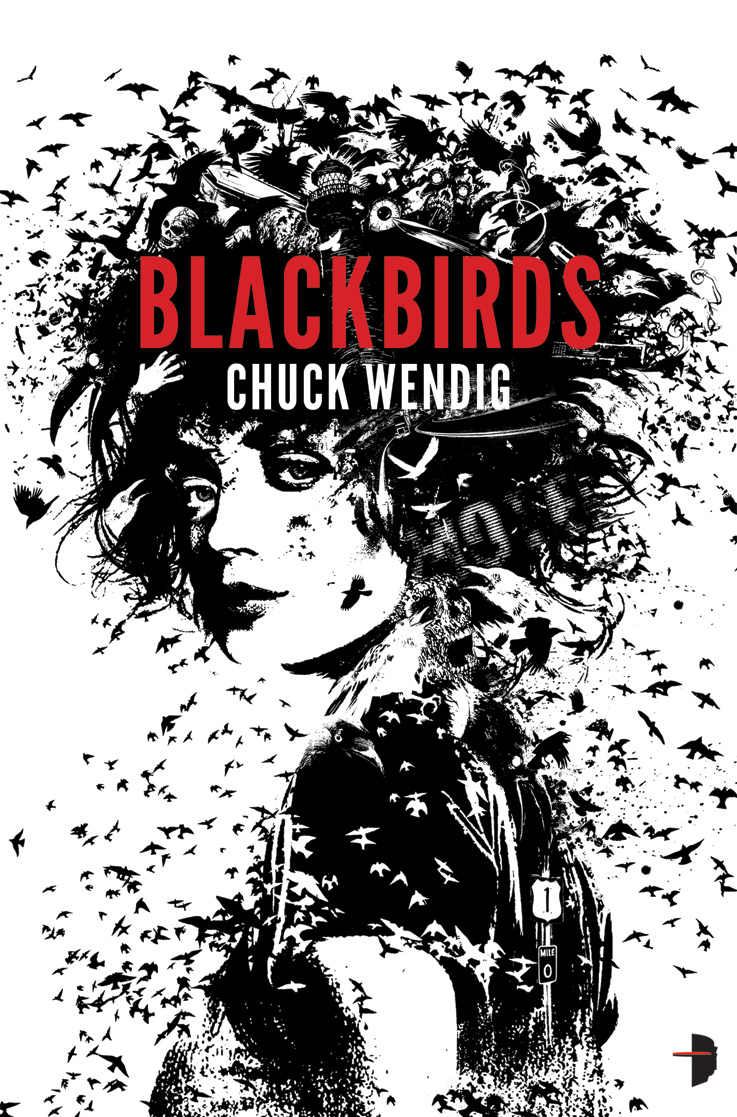
Book Review: Blackbirds, by Chuck Wendig

 4.5/5

If Joss Whedon and Chuck Palahniuk had a love child, she might be called Miriam Black. A foul-mouthed and totally kick-ass borderline sociopath, Miriam also sees the future . . . or at least one particular kind of future: your death. With a simple touch of her hand, she knows exactly when, where and how you're gonna snuff it, and it's mostly not very pretty.

Neither is her life. When we meet Miriam -- in a cheap hotel room, posing as a truck-stop hooker -- it's just another day for her. On the grift, she makes her way by profiting from deaths foreseen. Having long ago come to the conclusion that she can't beat fate, so might as well profit from it, the self-proclaimed "vulture," is watching the clock on her current seedy mark (it's three minutes and counting) so she can liberate his cash and valuables, and move on. You can imagine how it's hard for her to make friends.

But when Miriam hitches a ride from nice-guy trucker Louis, she senses her own presence at his strange and violent death a few weeks hence. The vision haunts her, and somehow, a chance ride turns into an uneasy friendship, which kick-starts a twisted race to beat the reaper -- and maybe change the future.

I bought this book because I couldn't resist its gorgeous cover art, but Chuck Wendig really delivers the goods: Blackbirds is a fast-paced, ultra-violent supernatural noir, with cheeky dialogue and a vivid pop-culture vibe. 4.5 stars instead of 5, because sometimes the writing is too self-consciously edgy (a freeway has a "crusty, broken dividing line like a spattered stripe of golden piss"), but just as often lines made me laugh out loud.

At the time I picked it up, I was unaware that Blackbirds is the start of a series. Sometimes this really bugs me -- can nobody write a stand-alone anymore? -- but in this case, I'm glad. Miriam may have morals deep into the grey zone (and a mouth like a sailor, and a serious drinking problem . . .) but she's good, snarky company. And contrary to some other reviewers, I find Miriam to have a very believable "female voice." She may not be a role model, but like Arya Stark, Lisbeth Salander, or any number of Whedon's warrior women before her, she's one girl that doesn't take any shit. Even from Fate.