Showing posts with label dark fiction. Show all posts

Sunday, December 30, 2012

Book Review: Ghosts by Gaslight, ed. Jack Dann and Nick Gevers

4.5/5

Lovers of the classic Victorian/Edwardian ghost story will find much to like in Ghosts by Gaslight, a generally excellent collection featuring names like Margo Lanagan, Laird Barron, Garth Nix and Robert Silverberg. It is, as other reviews have mentioned, slightly lighter on the "steampunk" than the subtitle suggests -- there are certainly no bloody big airships. if that's your expectation. However, the spirit of limitless invention and curiousity that pervaded the era hangs like London fog over the book, and the supernatural disruptions here generally occur as result of humanity's hubris, of meddling with forces beyond our ken in our hunger for invention, discovery and dominance.

So . . .  I'm going to start by being contrary: GbG contains plenty for the steampunk set: loads of mysterious clanking machines, menacing automata, eerie floating constructions, and far-out communication devices -- some of them downright terrifying. In Richard Harland's "Bad Thoughts and the Mechanism," a miraculous nightmare-removal machine reaches critical mass. An inventor working on wireless communication taps into a distressing uncanny signal in Peter S. Beagle's melancholy "Music, When Soft Voices Die." And in Lucius Shepard's novella-length "Rose Street Attractors," a peculiar scientist builds rooftop machines intended to improve London's filthy air. Curiously, they trap revenants rather than smog. And among them is his mysteriously murdered fiancĂ©e.

The collection also features plenty of Victorian supernatural staples like that ghostly lady bent on revenge; for starters, there's a dead twin in the mirror in "The Grave Reflection," by Marly Youmans. An unscrupulous spiritualist is after more than his patients' money in John Langan's uncanny "The Unbearable Proximity of Mr. Dunn's Balloons." A brave and resourceful young hero struggles with a supernatural curse and his own (vividly drawn!) terror in "The Proving of Smollett Standforth" by Margo Lanagan; and we see the brutal consequences of challenging the alien wild, in the bloody and cleverly-named hunting yarn, Laird Barron's "Blackwood's Baby."

On the lighter side, Garth Nix cross-breeds Conan Doyle with R.L. Stevenson, adding just a touch of Lovecraft, to gruesome yet hilarious effect in "The Curious Case of the Moondawn Daffodils Murder." And in "The Summer Palace" (set in the world of his Well-Built City Trilogy), Jeffery Ford's irascible bizarro-world Sherlock, Physiognimist Cley, faces off with a malignant drug-induced spectre, all the while controlling the unbearable urge to murder his witless partner, Chibbins.

Anthologies are often uneven by their nature (and there is at least one story here that just didn't do it for me), but Ghosts by Gaslight works: a rich tapestry, diverse in style yet thematically cohesive. So glad I picked this one up . . . it's a keeper.

Thursday, December 06, 2012

Book Review: The Year's Best Dark Fantasy & Horror 2012, ed. Paula Guran

4.5/5
Dark fiction editrix supreme Paula Guran has put together another huge, mostly excellent selection this year, with enough variety to please most tastes. Here you'll find everything from cowboys vs. vampires, to pitch-dark fairy-tale revisions, to zombie baseball. There's also a visit to Marie Laveau, a "Maltese Unicorn," a  non-zombie apocalypse (for a change), a sand dune that predicts death, and a wardrobe that contains the whole sea.

She's also managed to draw some very well-established names -- like Stephen King, Charles de Lint, Caitlin Kiernan and Joan Aiken -- to sit side-by-side with relatively new talents. Some of my favorites include:

A book-lover's nightmare set in a dystopian near-future San Francisco, Glen Hirshberg's "After-Words" introduces the crazed leader of a book-cult whose end-time plans rely on remarkably old-fashioned methods. Hirshberg, a fellow SF denizen, always captures the tiniest nuances of the city, right down to the smells, night sounds, and neighborhood weather (yes, in SF we have different weather in different neighborhoods). Since the world in this story is quite grim, the verisimilitude adds an extra dose of shiver for me.

Joe R. Lansdale's "The Bleeding Shadow" has a Lovecraft-on-the-bayou vibe. Callow bluesman Tootie makes an unwise trade at Cross Roads Records: in exchange for a drop of his blood, he gets a platter full of unearthly music that, when he plays it, bequeaths him equally unearthly musical skills. Unfortunately, it also opens a doorway for those pesky things that should not be. (And if you like this story, I'd highly recommend picking up John Horner Jacobs' awesome novel Southern Gods.)
Yoon Ha Lee's "Conservation of Shadows" re-visions the ancient myth of Innana's journey to the Underworld as a MMORPG dungeon-like challenge, complete with mazes and inventory slots. I'd never read Lee's work before, but the juxtaposition of an eons-old tale with a futuristic gamescape makes for a memorable story, and Lee's language is beautiful and poetic.

"The Lake" by (the mellifluously-named) Tannarive Due, delivers a sneaky yet genteel brutality with the story of Abbie LaFleur, a Bostonian transplant to the deep south . . . where she really takes to her new environment.

And Laura Anne Gilman's "Crossroads" puts a quick and clever new spin on the standard deal with the devil.

I could go through the whole book like this. I am such a sucker for the short form, and Guran's choices are almost always top-notch: out of 33 stories, only one or two are a little meh, and that's probably just down to personal taste. (In fact, I'm not even gushing about other favorites -- Maureen McHugh's emotionally savage "After the Apocalypse," Elizabeth Hand's eerie "Near Zennor," and Tim Powers' clever and creepy "A Journey of Only Two Paces" -- because I have or plan to write about them in separate reviews of their authors' own collections.)

Verdict: if you like horror, and you like short stories, put this 2012 collection on your holiday wish list -- it's a real treat.


Tuesday, November 27, 2012

Book Review: The Orange Eats Creeps, by Grace Krilanovich


 2/5 -- MA-LSV

I had been looking forward to reading The Orange Eats Creeps for a long while. The glowing reviews! The blurbs that boldly proclaimed it a "new literature"; the future of horror! The shock, the grit, the awe, the really freaking weird cover . . ..

Meth and cough syrup junkie (maybe) vampires, Pacific Northwest, the 90s. Spreading dis(ease) and nihilism, riding the rails, hiding in the woods, stealing what they need. Told from the seriously damaged point of view of the only female running with a group of lost boys while ostensibly looking for her missing foster home "sister," TOEC is really mainly about these: body fluids, unsafe sex in gas station bathrooms, smoking, drinking, drug-overdosing, waking facedown in vomit in a grocery store breakroom. Facedown in blood behind a 7-11.  And again. And again.

I wanted to like this book, and I indeed did, at first. Krilanovich's fractured, stream-of-consciousness style suits the subject . . . the problem is not with the language, but with the hollow, drifting plotlessness of the thing. (Okay, drifters drift -- perhaps that's part of the point, but it does make for pretty repetitive reading.) Also?  Krilanovich was only about 14 years old when Kurt Cobain died. True, her main characters aren't meant to be that much older -- 16, 17 -- but there's this sense of trying too hard to be cool and affectless, of shock for shock's sake, lurking beneath her ugly/lovely, Burroughs-esque prose. (Truth: I don't much like Burroughs, either. If you do, you might like this.) Bottom line is I don't buy it, and I've lost interest in how (or whether) the story actually ends.

I'm going to admit here that I only made it a bit over two-thirds through TOEC -- what could have been a mash-up of On the Road and Requiem for a Dream just wound up mushy, monotonous and seemingly endless. I prefer the other "new voices" of horror -- check out the late Paul Haines for a more authentic, muscular version of self-inflicted Gen-X misery. In the end, TOEC is retroscope nostalgia for a fin de seicle ennui that ultimately imploded out of its own tiresomeness. Trust me; I was there.

Monday, October 22, 2012

Book Review: 99 Brief Scenes from the End of the World, by T.W. Grim

99  Brief Scenes From The End Of The World 3.5/5 -- MA-LSV

This book started out as a 2.5 and performed the unusual feat of raising itself to a 3.5 by the time I finished it. 99 Brief Scenes From The End Of The World  was stealthy, sneak-up-on-you-good, despite some intrinsic flaws, and I'm glad I stuck with it.

The bad news first: Right out of the box I was irritated that the structure of the book was not as implied by the title. I expected something more like David Eagleman's strange and wonderful Sum: Forty Tales from the Afterlives, only with splatterrific zombie gore. So, when characters and locales began to make repeat appearances, I had to revise my expectation (99 unique pieces of apocalyptic flash-fiction), to reading what is better described as a novel with 99 chapters. These are not always "brief scenes," and some are a bit filler-y, not strictly necessary to the story as a whole. It seems to me that a final round of edits could have pulled this all together into a tight, suspenseful novel not reliant on the random titular number for its structure.

Now for the good news: Grim's book does have a number of things going for it; despite my initial irritation I found it impossible to put down. First and foremost, Grim -- a talented, descriptive writer -- does good character work. Once I finally got to know the core cast of survivors, I became invested their fate(s), and admired the way his craft allows their singular stories to eventually dovetail. Some of the global-picture characters (the foaming-at-the-mouth US President, or the morality-challenged leaders of a Japanese science/weapons lab) certainly might have been excised or toned down a wee bit. Though I suppose they serve to give us a window into the global situation, I found that the struggle for survival (and sanity) of the everyday citizens was more tethered in realism, and gave me more to sink my teeth into.

Speaking of which . . . absolutely key to this particular genre is the splatter, and Grim pours forth an endless stream of surprisingly innovative mayhem. The man knows his gore, and and has a million ways to spill it. in fact, a couple of unbelievably disgusting scenes really worked their way under my skin -- and I eat dinner while watching "The Walking Dead," so do the math. Grim also conceives an unusual twist on the now-standard zombie/rage virus trope (tiny spoiler: it's neither one!) which might allow a continuance of the story . . . something challenging to achieve when writing about an extinction-level event.

Because the unexpected twist piqued my interest, and because it takes a lot to actually gross me out, I not only upgraded this book to "liked a lot" status; I'll happily read any follow-up work Grim gets out there.

Friday, September 07, 2012

Book Review: The Horror of Lisa Mannetti

4.5/5 -- MA-LSV
3/5 -- MA-LSV


 (Spoiler warning in full effect.)
This has been a damnably difficult review to write; I read both of these back-to-back a couple of weeks ago, and am still not sure what to make of Mannetti's freaky and deeply disturbing modern gothic. The Gentling Box won the Bram Stoker for Best First Novel in 2008; Deathwatch is made up of two novellas -- Dissolution (a 2010 Stoker nominee for Long Fiction) and Sheila Na Gig. All three tales, though varied in setting, explore similar psychological ground, and some of the themes -- including necromancy, blood sacrifice, possession and (in particular) medical horror and taboo sexual transgressions -- are most unpleasant. As in, "WTF is wrong with Lisa Mannetti?" unpleasant. Of course I intend no insult; from the interviews I've read she seems like a warm and intelligent woman with a quick sense of humor, someone you'd like to chat with over tea or a beer. Which makes these dark, unforgiving, and ultimately rather misogynistic stories all the stranger. But in the horror field, the provocation of, well, horror, in the reader is kind of the point . . . right?

Set in the Romany culture of Hungary and Romania in the 1860s, The Gentling Box is as claustrophobic as a gypsy caravan, and as bone-chilling as an open grave. Through skillful, atmospheric prose, intense research and a wicked imagination, Mannetti recreates a world where fear, superstition and magic still hold sway; impeccably detailed, exotic enough to feel like a dark, bloody fairy tale, this book is definitely not for the squeamish. The Gentling Box is the tragedy of horse-trader Imre, his Romany wife Mimi, and their daughter Lenore. The two women become targets (and in Mimi's case, a meat-sack) for the ghost of Anyeta, Mimi's scheming mother, in life a powerful gypsy witch with a lust for immortality (among other things). Anyeta's power springs from "The Hand of the Dead," a repulsive fetish that grants the possessor power over life and death, and her goal is the acquisition of a fresh body. Anyeta's assault on the family includes poisoning the desperately protective Imre with disease and hallucinations, particularly sexual illusions -- she seduces and mocks him while possessing his wife's body, and curses him with unbearable and humiliating desire for the adolescent Lenore. The more Imre struggles to save his family from Anyeta's foul gypsy curse, the more it  tightens around him, until he's left dying and helpless, faced with an impossible choice. There's no question this deserved a Stoker: The Gentling Box, though unrelievedly dark and dreadful, is ambitious and uniquely haunting.

However, the novellas that make up Deathwatch are more problematic for me. That they again feature wicked women wielding supernatural powers to manipulate men into destroying other women (children, really) is what disturbs and somewhat dismays me. In Dissolution we meet another ghost, the mother of twelve-year-old conjoined twins Abby and Ellie, who seeks to live again through the body(ies) of her daughters. Again the ghost plays manipulative erotic tricks, this time upon the young surgeon  burdened with separating the twins, and to even more disastrous and disgusting results. In Dissolution, the medical/body horror works, but the young doctor's slide into madness and pedophilia plays like a repetitive and far less subtle version of The Gentling Box's horrors. And in Sheila Na Gig, an Irish crone uses ancient fertility magic to keep her family and its fortunes firmly under her control. If I told you her manipulations result in several deaths and an adolescent girl incestuously impregnated, I think that might be enough of the plot with which to make my point.

So here it is: the but-face. You know I love me some horror, the darker and more hopeless the better. I also  love the way Mannetti writes . . . The Gentling Box is unforgettable and alone warrants her a place at the big kids' table. But so far my experience with her work has left me equal parts impressed and repulsed. I think her various violations of the body -- possession, radical surgery, and the twisting of the erotic to make it unpalatable and unnatural -- work, even as they are profoundly disgusting. But I can't say that the repetitive theme of violence done to women by other women  (using men's lust and gullibility as their weapons) is a good look for any writer to be stuck in, let alone a woman. I'm pretty shock-proof, so when something makes me want to throw up on a book, that's news. Dissolution in particular openly crosses a line that is difficult to stomach. I'm no prude, but there were points at which I felt contaminated by the text.

Now . . . is that good horror or not? 


Friday, August 31, 2012

Book Review: Mockingbird (Miriam Black #2), by Chuck Wendig

5/5

Ass-kicking "vulture" Miriam Black* is back, and trying to make a go of "normalcy." Sure, she's no longer grifting on the back of her visions of death, but then she's also dying a little herself every day. Sharing an Airstream with trucker Louis (who's never home), stifling her visions, and working the checkout counter at a crappy Jersey Shore convenience store just isn't cutting it. So when one more sunburned bitch in a muumuu makes a crack about Miriam's gloves . . . they come off. Both literally and figuratively. And we all know where that can lead.

Pink-slipped and pissed off, she's ready to blow town when Louis offers her a last-ditch peace-offering. He has a friend, a teacher at an exclusive all-girls boarding institution, who is willing to pay for Miriam's "talent," and she finds herself almost too eager to agree. Easy, in and out, right?

But as we all know, boarding schools just scream perverse and creepy, so she's not getting away that easy. When a casual encounter with a smart-ass student brings on a debilitating vision of the girl's torture and death at the hands of a bird-masked butcher, Miriam feels compelled to see what she can do about twisting Fate. Again.

While still rocking  plenty of Miriam's patented irreverent snark, and a bunch of epic fights (man can this girl take a beating -- she's either a Slayer or related to Harry Dresden), this book delivers a more introspective Miriam. We learn more about her seriously damaged history, and that recently, she's had a frequent visitor. She calls him  "The Trespasser," and he likes to arrive out of nowhere in the shape of a dead lover, the back of his skull blown off, delivering ominous messages regarding the "work" she has to do. Which is suddenly somehow related to the girls of the Caldecott School. So there goes Jersey . . . and the gloves. Who wants normal anyway?

Bravo, Mr. Wendig. A sequel that's as good as the first, possibly better (the yellow-line metaphors are certainly much more effective* . . . melting butter pats FTW!), Mockingbird also significantly ups both character development and the creep-factor, with Miriam facing a truly insidious and deeply disturbing adversary. A bit less noir and more horror than Blackbirds, this book kept me up late into the night, alternately cracking me up and building up dread . . . the twisted twists keep coming right to the end. Can't wait for #3 -- Cormorant -- due in 2013.

*See my review of Blackbirds (Miriam Black #1) here.

Wednesday, August 15, 2012

Book Review: Kin, by Kealan Patrick Burke


4.5/5

 Kin begins at what is more usually construed as an ending: on the well-trod path of the "final girl" staggering away from a massacre, the lone survivor after a family of backwoods cannibals takes an unhealthy interest in a group of teenage backpackers. (What's the big deal?, I thought, slasher movies and torture porn. Yawn.)

But then . . . the story turns itself inside out and slaps the reader upside the head by becoming not merely revenge fiction (though it's that, too), but an investigation of the ripple-effects of an unthinkable crime, and the ways in which formidable bonds can form from even the most tenuous connections in times of crisis. For Burke, the word "kin" is key, and the story clearly implies a broader sense of "family" than just that of the bloodthirsty Merrill clan.

Kin is told from multiple, disparate points of view, all of which cross and weave together seamlessly as the hold-your-breath climax approaches. Among the sharply delineated characters are Claire, the survivor of unthinkable horrors; Peter, a slow but kind farm boy who, along with his father, finds the dying Claire on the road and takes her to the local doctor; Finch, a struggling Iraq war vet and the brother of Claire's boyfriend (now numbered among the cannibalized dead); and Luke, eldest son of the God-fearing, torture-loving, and flesh-eating Merrill clan. Burke's acute psychological profiles invite the reader to empathize not only with the crippling PTSD and survivor's guilt of victims, but also to approach an understanding of the repugnant family values that breed savages.

You should know what you are getting into when you pick up Kin: the violence level is exceptionally high and graphic (although one might intuit that from the blurb). Burke's book is certainly not for the faint of heart, but once you get through the first few raw, stomach-churning chapters, you'll find the payoff in beautiful (and hideous) prose, imaginative detail that takes you places you never wanted to see, well-turned dialogue and believable characters, and a tautly constructed plot that keeps twisting until the very end. Kin gets four-and-a-half stars and not five because of one scenario that felt a bit hard to swallow, but it's a major spoiler, so I won't share it here. Suffice it to say, I won't be able forget this novel anytime soon.

Wednesday, July 18, 2012

Book Review: Occultation and other Stories, by Laird Barron

 4.5/5

Barron’s second book of short stories absolutely delivers on the promise of his debut volume,  The Imago Sequence and Other Stories, and is in fact an even more accomplished and various collection, one in which his writerly scope, symbols, thematic preoccupations and chilling mythos all find room to grow. It's also deeply, deeply disturbing.

In my review of TIS I noted that, in keeping with the noir vibe of the collection, most of Barron’s protagonists were “tough-guy” types. Occultation, in contrast, offers a number of stories which prominently feature women, and the female voices and tragedies feel true . . . make what you will of the fact that each one is batshit insane. (Hell, most of Barron’s characters end up that way, or worse, regardless of gender.) Here, we meet Danni, a recent widow with an intermittent fugue state and a persistent urge to rejoin her dead husband in “The Lagerstatte”; in the Machen-esque “Catch Hell,” grieving mother Katherine and her anthropologist husband visit The Black Ram, an inn with an unsavory history and a reputation for black magic, to which they have come to enact an unspeakable ritual. (Sidenote: I've just run across another fantastic story featuring The Black Ram -- “Blackwood's Baby, in  The Best Horror of the Year (Vol. 4). I enjoy watching worldbuilding in progress and love the way Barron is populating his with referents that appear across several works.)

Barron shows a real flair for the dialogue of couples, the petty jibes and secret histories they share lurking just beneath the surface. In the title story two lovers in a motel room speculate about a seriously freaky spot on the wall while passing a bottle; in “--30--” (which feels like an hommage to “Who Goes There?”), two naturalists, former lovers, are thrown together in isolation on a three-month wilderness project. Their repartee is barbed, quick and clever, until strange things start happening and the discovery of an ancient artifact tips them over into insanity and fatal paranoia.

Barron’s developing mythos also gains steam in Occultation. From the heartbreaking first story, “The Forest,” in which we meet the mysterious Dr. Toshi Ryoko, who seems to have a line on the horrors in store for the human race, to “Mysterium Tremendum,” in which Barron's cthonic cult  sprouts a text of its own – The Black Guide, a rare guidebook through the more unpleasant nether regions of Washington State. Following its lead, a group of weekend outdoorsmen stumble into a special kind of hell, one which contains revenants from their own troubled histories.

My favorite in the collection is the masterful haunted house story “The Broadsword.” This was the one that made me leave the lights on. Set in a Victorian apartment building which has seen better days, this is where we finally learn the name of the horror haunting Barron’s mythic landscape: the "children of Old Leech" have come out to play, and you will not forget them anytime soon. And once you have met, they will not forget you, either. Prepare to see a good deal more of them.


Tuesday, July 17, 2012

Book Review: Martyrs & Monsters, by Robert Dunbar

 4.5/5

I devoured Robert Dunbar’s excellent Martyrs & Monsters almost entirely at one sitting. A collection of short works, the stories in this book are so various in tone and style that it almost felt as if I were reading an anthology of tales by many different authors. Okay, that’s not entirely true, as some of the stories are intended to expand upon or follow others, but the scope is truly impressive. Ranging from simply melancholy to outright tragic, from splatterpunk to whimsy, the primary commonalities are a graceful economy of language and an uncanny insight into the deepest and strangest parts of the human animal.

The absolute standout of Martyrs & Monsters would have to be the creepily lyrical “Mal de Mer,” which reminded me, weirdly, of both Ramsay Campbell’s incredibly disturbing “The Voice of the Beach” and the heartbreaking The Awakening by Kate Chopin. Strange bedfellows, indeed, but this story of repression and release, desire, disappointment, fear and compulsion, contains perhaps my favorite lines in the book, ones which immediately reveal the soul of the protagonist: “In her younger years . . . her essential lack of warmth had discouraged colleagues from bonding with her. It had that effect on most people. Yet she believed herself not to be entirely lacking in empathy, only in its myriad pitying applications and ubiquitous expressions, which she considered both squalid and pointless.” (Maybe this just reminds me a little bit of me.)

On the other hand, the punchy gross-out of “Saturday Night Fights” is all rock & roll, splatterpunk and 50s B-movie, rolled together in one juicy and satisfying package. You’ve got to love a story that begins “By the time the two of them woke up, their friends had already met with disgusting deaths. But then they both slept pretty late that day.” And the monster? Personal phobias notwithstanding, just ew.

“Gray Soil” and “Red Soil,” two of the linking stories, are told in simple, almost mythic language. Together, they uncover the blood-soaked history of a desolate place – the first a story of a mother’s brutal sacrifice, the second a tale of unchecked appetites, human and otherwise, and again of hard choices made for the sake of loved ones.

Other favorites include “The Folly,” a southern gothic almost-spoof which involves an eccentric family, Bigfoot, and a house shaped like an alligator; “High Rise,” the story of a nymphomaniac ghost and her victim(s); and “Killing Billie’s Boys,” an oddball tale of warring witches and their rent-boy catspaws.

And, despite my going on, that’s fewer than half of the stories in Martyrs & Monsters, each one unique and haunting. Half a star off for my only complaint (and it’s not that dire), the sometimes distracting typos, of which there were many. Possibly this is just a side-effect of the e-book format, and almost certainly out of the author’s hands, but it’s the kind of thing that can break the spell of an otherwise compelling narrative. At any rate, I look forward to reading more from Robert Dunbar, a truly literary fabulist.


Thursday, July 12, 2012

Book Review: The Place Called Dagon, by Herbert S. Gorman

 4/5

This great little weird novel was recently rescued from obscurity by publishing house Lovecraft's Library. According to Lovecraft scholar S. T. Joshi, HPL mentions having read The Place Called Dagon in his letters (1928) and also in Supernatural Horror in Literature. Though he called it "purile" at the time, there is much academic speculation that TPCD may have influenced classics such as "The Dunwich Horror" and "Dreams in the Witch House," and perhaps fear of comparison even played a part in HPL's reluctance to release "The Case of Charles Dexter Ward." Conversely, it is almost certain Gorman had never heard of Lovecraft -- the name "Dagon" wasn't original to HPL's 1917 short story -- and just happened to stray into the weird for this one novel. (Gorman wrote several, though he is now mostly forgotten).

Despite its anomalous state, TPCD actually sits quite proudly in the weird tradition, somewhere between Blackwood and Lovecraft: in some ways it recalls Blackwood's classic tale "Ancient Sorceries," but instead of time-haunted Europe, is set instead in HPL's eldritch and inbred New England.

(Mild spoilers follow.)

Gorman's hero, a young doctor who has assumed a practice in an out-of-the-way Massachusetts valley, soon begins to suspect ancient and evil secrets persist beneath the hard, practical veneer of the town of Marlborough. Lo and behold, it seems the locals are in fact descended from survivors of the Salem witch-cult, and strange rites are being resurrected in the dark woods. The cast contains some pretty stock weird figures, including an arrogant arcane scholar, his disturbingly alluring wife, and a dour and malevolent preacher. Sometimes assisting the determined doctor in his search for the truth: Marlborough's now housebound former doctor -- a reticent (and mildly alcoholic) adviser on town matters; a beautiful and friendless orphan ingenue; and a stolid local farmer who is both kinder and cannier than he appears.

It's Gorman's rather modern writing which prevents TPCD from being "just" another forgettable pulp horror novel -- certainly, he's less long-winded than Blackwood and less purple than Lovecraft. His lyrical descriptions of atmosphere and landscape and keen insights into human motivation keep the tale interesting, and his candid take on female sexuality seems quite progressive for 1927. TPCD is a quick and enjoyable read, and deserving of being resurrected into the pantheon of the good weird. Four solid stars.

Book Review: Under the Dome, by Stephen King


Under the Dome: A Novel

5/5

Likely King's best novel in years, Under the Dome grabs you at the first page and never lets up, with a propulsive narrative that is both as disturbing as you might expect, and even more so. Everything you need to know is right there in the title: the town of Chester's Mill, Maine has become cut off from the world by a mysterious transparent "dome" which appears out of nowhere on a crisp fall day. No one can leave, and no one can enter. The town is on its own.

Less a traditional horror story (though there's plenty of gruesome moments), and more a hostage situation on a grand scale, UtD is most effective when showcasing the evil men (and all the other inhabitants of beleaguered Chester's Mill) can do when traditional moral structures collapse around them, when the world shrinks and becomes alien and full of menace, when any idea of a sympathetic, or even rational, god has gone the way of fresh supplies . . . and fresh air.

Along the way the reader meets a cast of characters roughly the size of a small Maine town; chief among them the corrupt Selectman who views the crisis as a golden opportunity; the adolescent whiz-kids intent on helping to solve it; the Revelations-spewing meth addict who runs the town's Christian (and only) radio station; the overtaxed PA who becomes the town's de-facto doctor; and leading the cast, a former soldier on the drift, who manages to just miss his opportunity to get out while the getting is good.

With strongly delineated heroes  -- flawed though they may be -- to root for, and plenty of despicable self-proclaimed "good guys" to hiss at (small-town cops and elected officials take rather a drubbing, as do unchristian Christians),UtD takes an inexplicable disaster and puts a human face on the toll it exacts. I won't say any more than this -- when I was halfway through the book, I couldn't imagine any way things could get worse for Chester's Mill. Fortunately, good old Uncle Steve's imagination is a long way from running dry.

Thursday, July 05, 2012

Book Review: The Light is the Darkness, by Laird Barron

 4.5/5

Conrad Navarro, modern gladiator with a genius IQ, is the apotheosis of all Laird Barron’s previous tough guy protagonists. He is their perfection – the imago, if you will – a poetic image which Barron invokes repeatedly in his body of work. The story of Conrad's transformative journey is violent, hallucinogenic, and terribly sad by turns; it's also surprisingly challenging in its execution.

Known simply as “the American,” Conrad makes his living fighting in ludi (singular ludis, after the games held in conjunction with Roman religious festivals): secret and meticulously orchestrated blood sports in which combatants fight to the death for the pleasure of the wealthy and powerful. Between bouts, Conrad obsessively searches for his missing sister Imogene, an FBI agent gone off the reservation on her own dark odyssey: she’s hunting the ancient, elusive and sinister Dr. Drake, a radical experimental physician who may have killed their cancer-stricken brother Ezra in a botched treatment . . . or was it an unspeakable ritual? Following her trail, Conrad finds the cryptic messages she has left for him, parlaying each into another step closer to his beloved “Genie,” and his own fate.

However, nothing in Conrad’s surreal world is as it seems. What really happened to Ezra and the others under Dr. Drake’s care? Why did his mother drive herself off a cliff, and what drove his father – less literally – around the bend? Why does Conrad, “a special case,” according to dear old Dad, seem impervious to death, and get stronger, heal faster by the day? And where has Imogene really gone?

What Conrad fails to grasp until it’s far too late is the extent of the conspiracy that enfolds his family, or the cruel cosmic game in which they are merely pieces on a board. In his blundering search for the truth, he has caught the attention of the darkness, and he will have to pay.

Short, fast and unapologetically brutal, The Light is the Darkness is a gut-punch that shares more stylistically with Barron’s first anthology The Imago Sequence than it does with his most recent (and more subtle) novel, The Croning . . . though one does get the feeling that all of Barron’s stories are taking place in the same savage world, that the cosmic horrors we meet are related, and that human beings almost always exist primarily as “provender” for their obscene needs.

At first I was mildly disappointed with LitD; so much happens so fast
 . . .  it's like like bright strobes illuminate various setpieces, and then, before you can make the necessary connections, it’s over. But it had crept into my brain and wouldn’t leave me alone, so I went back to it. Though it's just novella-length, its fairly experimental style requires a closer look in order to fully appreciate the layers of imagery and sometimes nonlinear plot trajectory. Upon a second reading, symbolic patterns and foreshadowing emerge, and cryptic hallucinogenic stream-of-consciousness passages that seemed intrusions on (or excursions from) the main storyline click into place and make Conrad's story richer and ultimately more horrific. For me, real enjoyment of this incredibly weird book demanded study. The Light is the Darkness may not be anybody’s idea of light summer reading, but once again Laird Barron challenges the prevailing assumption that so-called "genre fiction" can't also be intellectually challenging.

Thursday, June 28, 2012

Book review: The Scar, by China Mieville

5/5

The Scar is the second book set in China Mieville’s enormous and species-diverse world of Bas-Lag, and while it might help for readers to be familiar with its predecessor Perdido Street Station, it's not strictly necessary, as this is not strictly a sequel. It's enough to know that as the story opens our protagonist, linguist Bellis Coldwine, is fleeing her beloved city of New Crobuzan (the setting for PSS) in fear for her life. Unfortunately, Bellis has a tangential connection to the awful events that make up the narrative of PSS, and her friends and acquaintances have started disappearing in the resulting government investigation. Determined not to meet the same fate, Bellis hastily books passage working as a translator on the Terpsichoria, a ship bound for the distant colony of Nova Esperium. There she hopes to wait out the trouble, and eventually return home.

As her journey gets underway, Bellis – chilly by nature and in mourning for her lost life – remains aloof from her fellow passengers, though she acerbically records shipboard goings-on in a long, journal-like letter she means to send back to New Crobuzon at her first chance. Growing restless in the long, dull days at sea, Bellis finally strikes up a guarded friendship with Johannes Tearfly, a naturalist and fellow academic whose primary interests are in “megafauna” and exotic underwater life. She also grows curious about the hold full of "Remade" prisoners, intended to be used as labor in the new colony. (The Remade are the lowest class in New Crobuzan: usually criminals, whose punishment includes the forcible addition or alteration of body parts. These might be organic – beaks, claws, feathers, tentacles, extra human bits; or mechanical – legs replaced by steam-engine powered treads, arms replaced with tools useful in factories. The punishment generally fits the crime in some perverse way, and the possibilities are endless. In a world occupied by a multiplicity of "xenian" races, the Remade are among Mieville's darkest and most fascinating creations. But I digress.)

It's not long before Bellis is pressed into earning her passage, serving as translator in highly volatile and secret talks with New Crobuzon allies the Cray, who seem to have misplaced something large, top-secret and essential to government interests. There is clearly more going on aboard the Terpsichoria than meets the eye. When Silas Fennec, a mysterious passenger with enough clout to commandeer the ship, announces they must return to New Crobuzon immediately, Bellis is both alarmed and relieved.

And then pirates attack. Really. Just when the novel is building up a good head of espionage steam . . . pirates? Please don't let the narrative hard-left throw you – there will be many more – because now the action really begins.

Led by the mysterious and deadly swordsman Uther Doul, the pirates board the Terpsichoria and summarily execute the officers and most of the crew. The passengers, cargo and ship are then claimed for the legendary floating pirate city of Armada. (Another of Mieville's better conceits, Armada is a fully-functioning city-state, built from an endless array of ships captured over centuries, intricately refitted and lashed together. It is quite literally legendary, since the pirates of Armada leave nothing behind when they attack, and no one taken to their city has ever been allowed to leave.) The press-ganged Bellis understands her chances of getting home are now next to none.

But Bellis finds that Armada is not the lawless place she imagined: all the passengers, including the newly-freed Remade, are offered jobs and places to live. The political climate, while contentious, is relatively stable and egalitarian, consisting of several independent “ridings” in loose confederation, all overseen by a pair of mysterious leaders called The Lovers. In spite of her despair, Bellis begins working as a librarian in Armada's huge pilfered collection, and quietly getting to know her new home. But when a strange and important manuscript is discovered in the library, Bellis draws the uncomfortable attention of both Silas Fennec and Uther Doul – who serves as right hand to The Lovers. Drawn into their political machinations, her fate becomes inexorably bound with that of Armada itself.

I have given short shrift to some important aspects of this book – for example the moving subplot of Remade prisoner Tanner Sack, who finds his freedom and a modicum of redemption in his new maritime home; or the fascinating Uther Doul and his deadly quantum magic-fueled “Possibility Sword.” But to say any more (and there is so much more!) would be to deprive potential readers of the pleasure of discovering the myriad of strange beings and weird twists The Scar delivers before reaching its stunning climax.
Perhaps the most astounding thing about The Scar – a novel drawing on traditions as varied as the sea-shanty and “big-fish” yarn, political thriller, quantum theory and existential horror, and influences as disparate as Lovecraft, Borges and Melville – is that all the twists, turns and wildly complex narrative threads actually add up to something truly satisfying. Mieville not only builds a world so real you can see (and possibly smell) it when you close your eyes, he also sticks the landing like a gold medalist. The more China Mieville I read, the more in awe of his disturbing and fruitful mind I become. At this moment, I’m convinced The Scar is his best work – though I have no doubt he’ll surprise me again.


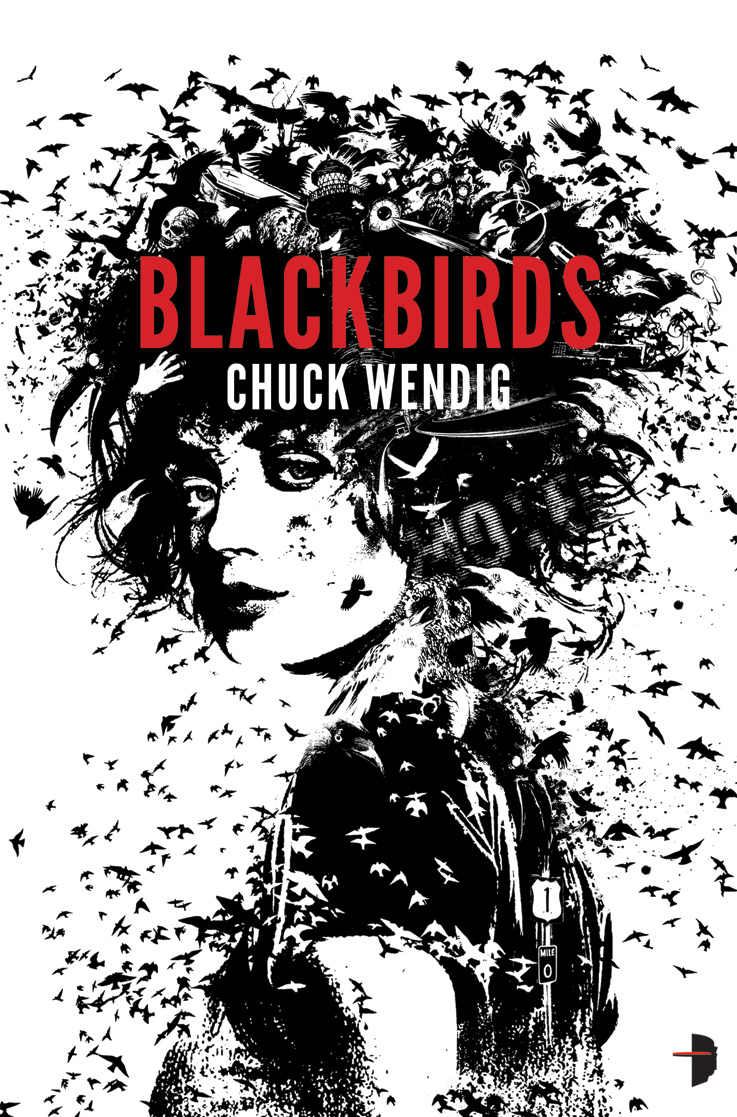
Book Review: Blackbirds, by Chuck Wendig

 4.5/5

If Joss Whedon and Chuck Palahniuk had a love child, she might be called Miriam Black. A foul-mouthed and totally kick-ass borderline sociopath, Miriam also sees the future . . . or at least one particular kind of future: your death. With a simple touch of her hand, she knows exactly when, where and how you're gonna snuff it, and it's mostly not very pretty.

Neither is her life. When we meet Miriam -- in a cheap hotel room, posing as a truck-stop hooker -- it's just another day for her. On the grift, she makes her way by profiting from deaths foreseen. Having long ago come to the conclusion that she can't beat fate, so might as well profit from it, the self-proclaimed "vulture," is watching the clock on her current seedy mark (it's three minutes and counting) so she can liberate his cash and valuables, and move on. You can imagine how it's hard for her to make friends.

But when Miriam hitches a ride from nice-guy trucker Louis, she senses her own presence at his strange and violent death a few weeks hence. The vision haunts her, and somehow, a chance ride turns into an uneasy friendship, which kick-starts a twisted race to beat the reaper -- and maybe change the future.

I bought this book because I couldn't resist its gorgeous cover art, but Chuck Wendig really delivers the goods: Blackbirds is a fast-paced, ultra-violent supernatural noir, with cheeky dialogue and a vivid pop-culture vibe. 4.5 stars instead of 5, because sometimes the writing is too self-consciously edgy (a freeway has a "crusty, broken dividing line like a spattered stripe of golden piss"), but just as often lines made me laugh out loud.

At the time I picked it up, I was unaware that Blackbirds is the start of a series. Sometimes this really bugs me -- can nobody write a stand-alone anymore? -- but in this case, I'm glad. Miriam may have morals deep into the grey zone (and a mouth like a sailor, and a serious drinking problem . . .) but she's good, snarky company. And contrary to some other reviewers, I find Miriam to have a very believable "female voice." She may not be a role model, but like Arya Stark, Lisbeth Salander, or any number of Whedon's warrior women before her, she's one girl that doesn't take any shit. Even from Fate.

Book Review: The Croning, by Laird Barron

5/5

The Croning
is a perfectly horrible book, and I mean that in high compliment.

It's rare that a horror story actually scares me these days (and more's the pity), but Barron's first novel is wrong in all the right ways, leaving behind a caul of unease, and a wicked dose of the cosmic heebie-jeebies. (I'm thrilled to admit that when I finished it last night, I left the lights on.) Also? Un-put-downable. The Croning sustains the poisonous adrenaline level of one of Barron's short stories over almost 250 pages; once you open the cover you are done for. But the faint-of-heart be warned: this is a seriously dark and unpleasant ride, with a sucking black hole where some might prefer redemptive resolution.

With each tautly descriptive and hallucinogenic page, the dread level ratchets up another notch, for both the reader and our "hero" Don Miller. Don, a  former  geologist and cave-expert now in his early 80s, has recently come to suspect that his notoriously unreliable memory is finally going for good. As Don settles into uneasy retirement in his wife's ancestral family home in the woods of the Pacific Northwest, he reviews his apparently charmed life: moderate wealth, adventurous travel, family and a 50-plus-year marriage with love of his life,the still-vivacious -- and still-successful -- archaeologist Michelle Mock.

But there is something wrong. Don feels a creeping dread about the house and the Mock family's mysterious history, as well as Michelle's long absences, unreliable itineraries, and violent mood swings. Now, Don's fears begin to coalesce into a pattern of nagging inconsistencies and memory-repression so terrifying as to indeed resemble dementia. This challenging timeline structure leaps back and forth across more than half a century of Don's life, methodically revealing the horrors that have been conspiratorially hidden from him until now, and unveiling the truly nightmarish source of Don's dis-ease -- his brushes with a cthonic cult that has flourished from before the dawn of time, and demands unimaginable sacrifice from its chosen acolytes.

In The Croning, Barron has fleshed out the rumors of "Old Leech" and his minions, who have appeared in certain of his short stories, creating an ancient and bloodthirsty mythology of Lovecraftian scale, but with a stench of cosmic horror that is entirely his own. It's sick, but I want more.


Book Review: After the Apocalypse, by Maureen F. McHugh

 5/5

After the Apocalypse as a title is a bit misleading -- evoking as it does zombies (there are only a few), nuclear winter, or some "Mad Max" scenario -- and yet it's also quite perfect. Because, like Tom Perrotta's The Leftovers, Maureen F. McHugh's thoughtful  collection of stories is really about how we, just us normal people, get up and get on with it after the unthinkable has occurred.

At heart, these are intimate tales about people and their strange new  lives: keeping family safe, finding work, finding food, losing their homes, their minds and their innocence. While some common genre tropes appear (a government "zombie reserve" that doubles as a fight-or-die penal colony; an unstoppable strain of avian flu that takes its sweet, relentless time to turn a human brain to mush; disparate strangers inexplicably drawn to converge in a particular place), the apocalypses -- yes, the plural form is required -- in these stories are equally the result of problems already on our doorsteps: natural disasters; overburdened and failing urban infrastructures; economic meltdowns; and machines that might just be smarter than we are.

With clean, evocative prose, a killer eye for detail, and a sympathetic, humorous (but never indulgent) view into the human condition, McHugh has crafted a work of speculative fiction about what humanity might stand to lose -- or just maybe gain -- when we are faced with the burdens of the end times already rearing their ugly heads. Her characters are not always kind, not always moral. But they are astute, funny and absolutely believable. (And as a bonus, one wears the coolest t-shirt ever: "If You're Really a Goth, Where Were You When We Sacked Rome?")
Overhaul alert!

I have just rescued this blog from the positively antediluvian year of 2007, with the intention of turning it into a book blog. (Good intentions, yadayada.) I will begin the arduous process of adding my reviews shortly.

Stay tuned!